

Super User
FDA Now Accepting Applications for the Voluntary Qualified Importer Program (VQIP)

FDA Now Accepting Applications for the Voluntary Qualified Importer Program (VQIP)
VQIP is a voluntary program in which food importers may participate to expedite release of their human or animal food shipments. FDA will not examine or sample shipments that are imported under VQIP unless warranted by public health reasons or for auditing purposes. FDA began accepting VQIP applications on October 1, 2018 and indicates they will review about 200 applications for the Fiscal Year 2020.
To participate in VQIP, an importer must submit an application to FDA and must:
- Have at least a 3-year history of importing food into the United States.
- Have a Data Universal Numbering System (DUNS) number. DUNS numbers are issued by Dun & Bradstreet (D&B) and can be obtained at: https://www.dnb.com/duns-number/get-a-duns.html.
- Use a filer/broker that passed its most recent FDA filer evaluation.
- Not import any foods listed on the Red List of any FDA Import Alert at the time of the VQIP application.
- Not import any foods subject to a class 1 recall in effect at the time of the VQIP application.
- Have a compliant history related to food safety and ensure that all applicable entities associated with the VQIP foods e.g. supplier, filer/broker etc. also have compliant histories related to food safety.
- Have each foreign supplier of their VQIP foods certified in accordance to FDA’s Accredited Third-Party Certification program.
- Submit to FDA a written Quality Assurance Program (QAP) for their VQIP.
- Not have been subject to Customs regulatory action i.e. penalties, forfeitures, or sanctions related to food safety within the past 3 years.
- Pay an annual user fee to FDA which FDA currently estimates to be about 16,400.00 USD/year.
According to FDA, once an importer is enrolled in the VQIP, FDA’s electronic entry screening system will release most shipments of the importer’s VQIP foods immediately after receiving the entry data from the Customs broker/filer.
Contact FDA Specialist today to find out how we can assist you in successfully applying for the VQIP!
What Exactly is the Legal Status of CBD Oil?

Update 12/12/18! Congress has passed the 2019 Farm Bill which, if signed into law by the President, will lift federal restrictions on hemp production. As CBD is derived from hemp, this could lead to changes in the legal status of CBD oil products which, as noted in the article below, are actually not legal to market as dietary supplements under current federal law. FDA has previously stated that CBD products are “excluded from the definition of dietary supplements”. (Furthermore, FDA still considers any product marketed with claims or implied claims to treat, cure, mitigate, or diagnose and disease to be a drug product which may not be legally marketed as a dietary supplement.) We will continue to provide additional updates to the regulatory status of CBD oil, so check back here soon!
Law enforcement officials have taken regulatory action against cannabidiol (CBD) oil, a popular dietary supplement marketed for it for relaxation, anti-inflammatory, pain relief, and other benefits. For example, the Drug Enforcement Agency (DEA) has seized CBD oil products held for sale in retail stores, and FDA has issued warning letters to companies marketing CBD oil as dietary supplements. Yet, the product remains widely available in stores across the United States. Hence, the legal status of CBD oil remains a confusing issue even to federal and local regulatory agencies at this time.
In spite of CBD oil being a popular product in the United States, FDA has stated in warning letters that CBD products are “excluded from the dietary supplement definition” and thus are subject to drug regulation under the Federal Food, Drug, and Cosmetic Act. In addition, CBD is a controlled substance under the Controlled Substances Act.
FDA appears to focus its attention on products that are marketed using claims of treating, curing, diagnosing, or preventing any disease. The Agency has issued warning letters to firms for marketing CBD products as dietary supplements with claims of treating cancer, diabetes, high blood pressure, arthritis, mental disorders, and other conditions. FDA charged these products as unapproved new drugs.
In order to legally market a drug in the United States, a new drug application must be approved by the FDA for the product. FDA recently approved a CBD drug used for treating epilepsy, and this drug has been placed in the schedule 5 list of controlled substances, which clears the way for the product to be sold as a drug in the US. However, CBD products not approved by FDA for drug use remain as schedule 1 controlled substances which are not permitted for medical use under federal law.
In summary, CBD oil remains a popular product sold in stores across America though federal officials have taken enforcement action against the product. FDA currently maintains its position that in order to sell a CBD product in the United States, it must be covered by a new drug application. The issue remains the subject of much debate, so stay tuned to www.fdaspecialist.com for further developments!
California Motorcycle Insurance
Boat Insurance Options
California Renters Insurance

California Auto Insurance

Foreign Supplier Verification Program (FSVP)

FDA has begun to enforce the FSVP rule which requires food importers to maintain documentation and records verifying that certain steps have been taken to ensure that the foods they import meet US food-safety standards. Most food importers have been required to comply since May 30, 2017, and FDA is already inspecting food importers ranging from small to large companies!
For the purpose of the FSVP, FDA defines the importer (“FSVP importer”) as the US owner or consignee of the food shipment. If no US owner or consignee exists for the shipment, then the FSVP importer may be an agent or other authorized representative of the foreign supplier or owner. Each food from each supplier must have its own, separate FSVP! For example, if you import bean paste from two different suppliers, then each bean paste must have its own FSVP. If you import bean paste and also import dried noodles from the same supplier then again, each food must have its own FSVP. Certain foods such as foods that comply with the seafood or juice HACCP regulation are exempt from the rule.
The FSVP includes activities that must be performed, reviewed, and documented by one or more “qualified individuals”. FDA considers a qualified individual to be a person with the education and or experience that qualifies that person to accomplish the specific activity for the specific food. The activities include:
Hazard Analysis and Risk Evaluation – For each imported food, a qualified individual must identify and document all known or reasonably foreseeable food safety-related hazards including physical, chemical, and biological hazards. The qualified individual must then evaluate the risk of each hazard based on the severity of the hazard and the probability of the hazard occurring if not controlled.
Supplier Evaluation – A qualified individual must evaluate the food safety performance of the supplier taking into consideration, factors such as any FDA inspection results, third-party audit results, any FDA regulatory actions (e.g. warning letters, listing on import alerts, detentions, refusals, etc.), and effectiveness of any recalls. Note that FDA does not approve the suppliers. The importer must evaluate and approve the suppliers from which they import their food products and document the evaluation.
Verification Activity – The importer must periodically have a qualified individual(s) perform an activity that verifies that the supplier (or other entity responsible for controlling the food safety hazards) is effectively controlling the hazards. These activities may include on-site audits, private lab testing, or review of the supplier’s food safety records.
For example, if the importer’s qualified individual determines that Salmonella contamination is a reasonably foreseeable hazard for a food, then the company may choose to have the product periodically tested by a private lab for Salmonella. A qualified individual must determine the frequency and method of the activity. If the hazard could result in serious adverse health consequences or death, the importer should have an on-site audit of the supplier’s facility performed by a qualified individual at least once a year.
Corrective Actions – A qualified individual must review and document any corrective actions taken by the supplier in response to any problems related to the safety of the food.
Re-evaluation of FSVP – The importer must have a qualified individual re-evaluate the FSVP at least every 3 years to ensure it is sufficiently meeting the requirements of the FSVP rule. If the importer becomes aware of any changes or other new information that could affect the safety of the food, then the FSVP must be evaluated at that time as well.
Remember that a person FDA recognizes as a “qualified individual” must perform and document the above activities! Contact FDA Specialist to assist you as the qualified individual for your FSVPs!
FDA Announces Compliance Dates for New Nutrition Facts Labeling Requirements
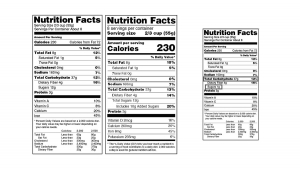
In 2016, FDA published new requirements for food nutrition labeling that significantly change the appearance of the Nutrition Facts panels and the information required to be declared on the label. FDA provided time for companies to implement the changes and recently announced the dates by which food products marketed in the US must comply with the new requirements.
The new requirements include changes to the format of the Nutrition Facts panel, rounding rules for the nutrient values, and the Reference Daily Intakes (RDIs) used to calculate the %Daily Values (%DVs). For example, the old RDI for Total Carbohydrate was 300g and the new RDI is 275g. So if a food contains 10g of Total Carbohydrate per serving, the original %DV was 10/300 = 3%. But under the new RDI, the %DV is now 10/275 which rounds to 4%.
Also, you must now declare Added Sugars in addition to Total Sugars. For example, if the product is a fruit juice that contains 30g of Total Sugar per serving, but only 20g of sugar per serving naturally occurs in the juice (the remaining 10g is added to the product), then you would need to declare 30g of Total Sugar and 10g of Added Sugar in the Nutrition Facts panel.
The new rule also requires that the amounts of the vitamins and minerals be declared in the Nutrition Facts panel in addition to their %DVs. For example, a product containing 10mg of iron should now declare 10mg as the amount in addition to the %DV which would be 60%. Furthermore, Potassium and Vitamin D must now be declared in addition to Calcium and Iron. Vitamin A and C are no longer mandatory nutrients (unless the label includes a claim about the nutrient e.g. “good source of Vitamin C”).
In addition, several new formatting requirements for the Nutrition Facts panel are now in place. These include new minimum font sizes, positioning of bars and text, etc. The required footnote has also been changed to “The % Daily Value tells you how much a nutrient in a serving of food contributes to a daily diet. 2,000 calories a day is used for general nutrition advice.”
For manufacturers with $10 million or more in annual food sales, the compliance date is January 1, 2020. For manufacturers with less than $10 million in annual food sales, the compliance date is January 1, 2021. Remember, FDA may not be enforcing these new requirements until the above dates, but the requirements are now in effect. That means you should now be adjusting your nutrition labeling to follow the new requirements!
Always remember that labels are usually the first thing FDA officials see when they examine your product. Contact FDA Specialist today to ensure your food labels comply with the new requirements and prevent FDA charges for labeling violations that can be easily avoided!
Richard Chiang worked for the FDA for 13 years beginning as a field investigator and entry reviewer and later worked at the FDA’s headquarters Center for Food Safety and Applied Nutrition (CFSAN)
Contact Us
Phone: (562) 882-4981
richard@fdaspecialist.com
5318 E. 2nd St. No. 198
Long Beach, CA 90803